AI Courses After 12th in 2026 - Eligibility, Fees, Duration, Salary & Top Colleges
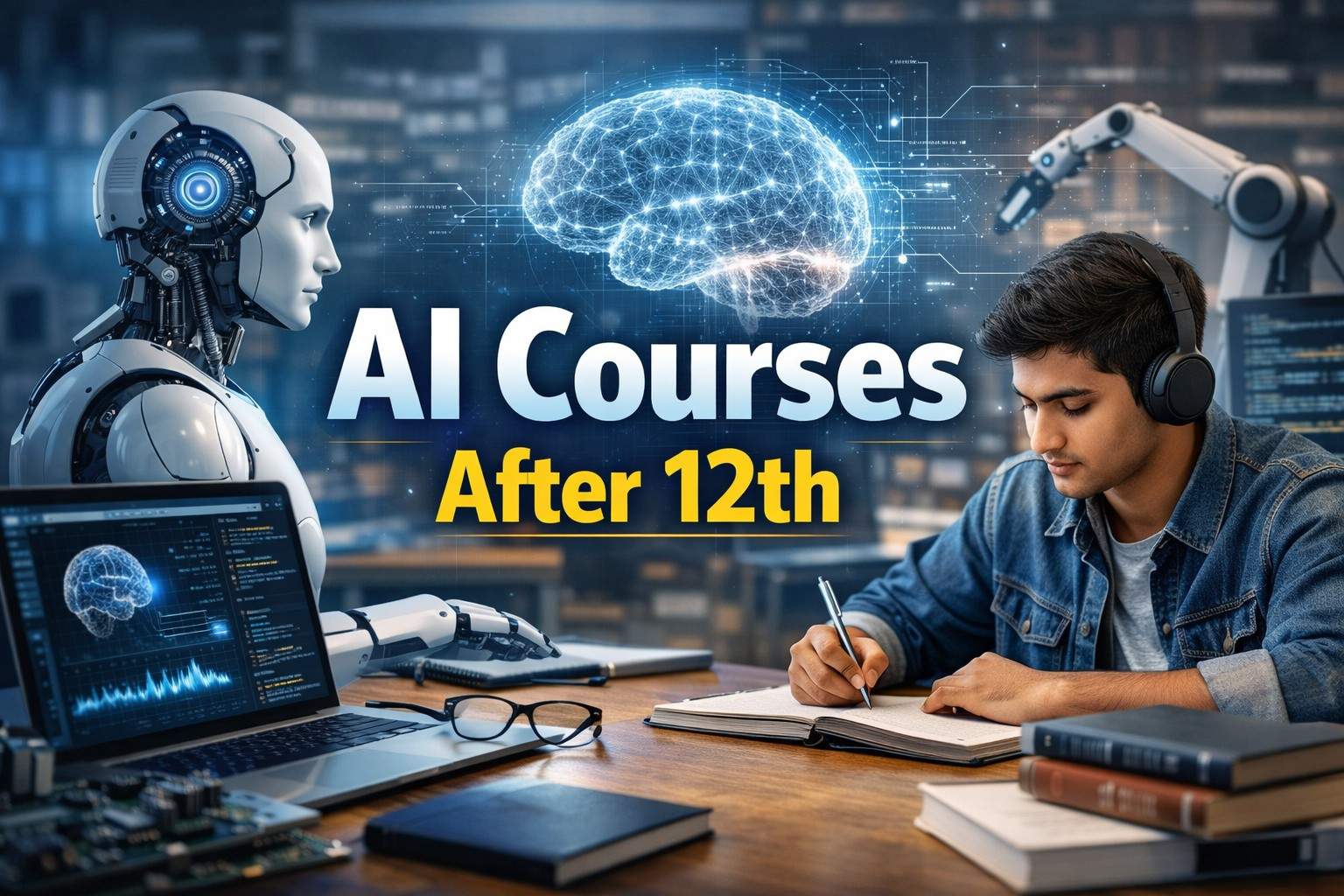
Choosing the right career after Class 12 is one of the biggest decisions in a student’s life. With technology evolving faster than ever, Artificial Intelligence (AI) has emerged as one of the most promising and future-proof career options. From smartphones and recommendation systems to healthcare diagnostics and smart cities, AI is already shaping how the world works.
If you are exploring AI courses after 12th and wondering whether this field is right for you, this detailed 2026 guide will help you understand everything-courses, eligibility, syllabus, career scope, salaries, and future growth in India.
What Are AI Courses After 12th?
AI courses after 12th are structured learning programs that teach students how intelligent machines are designed, trained, and used in real-world applications.
In simple terms, Artificial Intelligence focuses on:
- Teaching machines to learn from data
- Helping systems make predictions and decisions
- Automating repetitive and complex tasks
- Mimicking human-like intelligence through algorithms
What students typically learn in AI courses:
- Programming fundamentals (mainly Python)
- Data handling and analysis
- Machine Learning concepts
- AI models and real-world use cases
- Problem-solving and logical thinking
If you’re searching for an AI course after 12th, think of it as a blend of computer science, mathematics, and practical problem-solving. By 2026, AI is no longer optional—it’s becoming a core skill across industries.
Why Choose AI as a Career After 12th?
Artificial Intelligence is not limited to a single job role or industry. Instead, it acts as a powerful skill layer that enhances multiple career paths.
Key reasons to choose AI after 12th:
- High industry demand across healthcare, finance, IT, marketing, logistics, and manufacturing
- Diverse career options, including engineering, analytics, research, and product roles
- Strong long-term growth as businesses adopt automation and data-driven decisions
- Global opportunities, especially for skilled professionals
The future of AI in India looks promising due to:
- Rapid digital transformation
- Government initiatives in AI and automation
- Growth of startups and product-based companies
However, AI is not a shortcut career. Success depends on skills, consistency, and hands-on learning-not hype.
Types of AI Courses After 12th
AI is offered through multiple academic formats. Choosing the right one depends on your career goals and learning preferences.
Main types of AI courses:
- Degree Courses in Artificial Intelligence
- Diploma AI Courses After 12th
- AI Certification Courses (Online & Offline)
Quick selection guide:
- Want long-term roles like AI Engineer or ML Engineer → Degree program
- Want faster entry into AI tools and analytics → Diploma course
- Already studying another degree and want AI skills → Certification course
Bachelor’s Degree in AI & Data Science
A bachelor’s degree is the most comprehensive path for students serious about an AI career.
Popular degree options:
- BTech in Artificial Intelligence
- BSc in Artificial Intelligence
- BCA in Artificial Intelligence
What you learn:
- Python and advanced programming
- Machine Learning and Data Science
- AI algorithms and model training
- Real-world projects and case studies
These programs build a strong foundation and prepare students for advanced AI roles.
BTech in Computer Science with AI Specialization
A BTech CSE with AI combines traditional computer science with specialized AI modules.
Why this option is powerful:
- Strong core CS knowledge (OS, DBMS, networks)
- Flexibility to work in software or AI roles
- Easier transition into AI engineering or data roles
This course is ideal if you want both breadth and specialization in your career.
BCA with AI & Machine Learning
A BCA Artificial Intelligence course focuses more on practical coding and application development.
Key highlights:
- Hands-on programming approach
- AI and ML fundamentals
- Application-based projects like chatbots and dashboards
- Suitable for students less inclined toward hardcore engineering
This is a solid AI and ML course for students interested in software and applied AI after 12th.
Diploma & Certification AI Courses After 12th
Diploma and certification courses are designed for faster skill development.
Best suited for:
- Skill enhancement and portfolio building
- Students from non-science backgrounds
- Working professionals or beginners
Common focus areas:
- Python programming
- Data analysis basics
- Machine Learning fundamentals
- AI tools and cloud platforms
While these courses don’t replace degrees, they add strong practical value when paired with projects.
Eligibility Criteria for AI Courses After 12th
Eligibility depends on the course type and institute.
Typical eligibility requirements:
For BTech AI / BTech CSE with AI
- PCM background usually required
- Mathematics is compulsory in most cases
- Entrance exams like JEE or State CET
For BCA AI / BSc AI
- Multiple streams are accepted by many colleges
- Mathematics preferred, but not always mandatory
For Diplomas & Certifications
- Open to students from all streams
- Basic computer knowledge is helpful
Students weak in maths can still enter AI through BCA and gradually build foundational skills.
AI Courses After 12th Science (PCM Students)
For PCM students, AI is a natural career extension.
Advantages for PCM students:
- Strong logical and mathematical base
- Better understanding of algorithms
- Easier adaptation to Machine Learning concepts
Most AI courses after 12th science use national or state-level entrance exams. Early exposure to Python and problem-solving gives a big advantage.
Can Commerce or Arts Students Pursue AI Courses After 12th?
Yes, absolutely.
An AI course after 12th commerce or AI course after 12th arts is very much possible.
Suitable options:
- BCA in AI
- Diploma AI courses
- Online AI certifications
Skills to focus on:
- Python basics
- Data handling using Excel and SQL
- Logical reasoning
- AI tools used in business
Bridge learning in basic maths is enough to get started; advanced mathematics is not required from day one.
AI Course Duration After 12th
AI course duration varies by program type:
- BTech AI / BTech CSE with AI: 4 years
- BCA AI / BSc AI: 3 years
- AI Diploma Courses: 6 months to 2 years
- Certifications: 4 to 24 weeks
Longer courses offer deeper foundations, while shorter courses help with quick skill acquisition.
AI Course Fees in India
AI course fees in India vary based on institute type and delivery mode.
Fee structure overview:
- Government colleges: Lower fees, high competition
- Private colleges: Higher fees, better infrastructure
- Online courses: Affordable and flexible
Instead of focusing only on cost, evaluate:
- Curriculum depth
- Project exposure
- Internship opportunities
- Faculty and lab support
Value matters more than price.
AI Course Subjects & Syllabus
Most AI course subjects teach you to work with data and build intelligent systems.
What you actually learn (in simple terms)
- Python programming: Writing code for logic and automation
- Data analytics: Cleaning, exploring, and understanding data
- Machine Learning (ML): Training models to predict outcomes
- Deep Learning & Neural Networks: Pattern learning for images/text
- Math for AI: Basics of stats, probability, linear algebra (level varies)
- AI tools & deployment: Turning projects into usable apps
The artificial intelligence syllabus and AI and ML syllabus differ by college, but strong courses always include projects - because AI is best learned by building, not memorizing.
Career Opportunities After AI Course
AI careers are broad. Below are realistic AI job roles in India and what they involve:
1) AI Engineer
Builds AI features inside products - recommendations, predictions, automation. Works with data pipelines and ML models, and collaborates with software teams to deploy AI in real applications.
2) Data Scientist
Finds insights from data and builds models for business decisions. Uses statistics, dashboards, and ML. Focus is on problem-solving, experimentation, and improving outcomes using data.
3) Machine Learning Engineer
Takes ML models from notebooks to production. Works on model performance, APIs, deployment, monitoring, and scaling. Strong coding and system understanding is important.
4) Robotics Engineer
Works on intelligent machines and automation systems. Combines sensors, programming, control systems, and AI logic for motion, object detection, or decision-making.
5) AI Research Analyst
Studies AI methods, reads research, tests ideas, and supports model improvements. Common in labs, advanced teams, or research-oriented roles.
These are strong artificial intelligence career options beyond just “coding jobs.”
AI Course Salary in India
AI course salary depends on skills, projects, and the role - not just the degree.
General salary progression (approx.)
- Entry level: Usually moderate to strong, based on internships + portfolio
- Mid-level (2 - 5 years): Grows fast if you handle production systems
- Senior level: High, especially for ML engineering, applied AI, and leadership
Artificial intelligence salary in India is often higher in metro cities and product companies. AI engineer salary in India also varies by:
- Tech Stack (Python, cloud, ML ops)
- Project Quality
- Real Production Experience
Global roles can pay more, but they require strong fundamentals, communication, and proof of work.
Future Scope of AI in India (2026-2035)
The future scope of AI in India looks strong because AI is moving from “innovation” to “daily business use.” You’ll see growth in:
- AI startups and automation services
- AI in banking, healthcare, retail, logistics
- smarter manufacturing (Industry 5.0 trends)
- AI tools integrated into education and governance
This AI industry growth in India means the demand for AI professionals will expand - not only for engineers, but also for analysts, product people, and AI-enabled business roles.
The best part? Students who combine AI with domain knowledge (finance, marketing, healthcare) often grow faster than “generic” learners.
Entrance Exams for AI Courses After 12th
Entrance exams vary by course type.
Common exams:
- JEE Main
- State CETs
- University-level entrance tests
BCA and BSc AI admissions are often merit-based. Always check official admission criteria.
Best Colleges Offering AI Courses in India
Many reputed institutes offer AI pathways under BTech/BSc/BCA tracks. When evaluating best AI colleges in India or artificial intelligence colleges after 12th, check:
- Curriculum + Labs
- Industry Partnerships
- Internship Support
- Placement Ecosystem
Examples include government institutes, strong private universities, and industry-focused schools such as ITM School of FutureTech (Mumbai/Navi Mumbai region) for technology-oriented programs.
Why Choose ITM School of FutureTech for AI Courses After 12th?
If you’re considering ITM School of FutureTech, evaluate it like a career decision, not a brand decision. A strong AI course pathway should help students learn AI by doing.
Look for value signals like:
- Industry-aligned curriculum with applied AI + data focus
- Projects that build portfolio (dashboards, models, apps)
- Internship support and real-world exposure
- Learning tools used in industry (coding environments, data tools, cloud basics)
- Career readiness: aptitude, communication, interview prep
If you want an AI degree in Mumbai with a practical, project-first approach, this type of ecosystem can be useful for turning learning into job-ready skills.
Step-by-Step Roadmap to Start AI Career After 12th
Want how to become AI engineer after 12th? Use this simple AI career roadmap:
Choose the right degree
- BTech AI / BTech CSE with AI / BCA AI based on your stream
Learn Python early
- Start with basics → build mini scripts → solve problems
Build 4–6 projects
- Recommendation system, chatbot, prediction model, data dashboard
Do internships
- Even small internships teach real workflows and teamwork
Specialize
- ML engineering, data science, robotics, NLP, AI product analytics
These are practical steps to start an AI career without confusion.
Common Mistakes Students Make While Choosing AI Courses
Avoid these mistakes:
- Choosing AI only for salary
- Ignoring maths and logic basics
- Enrolling in shallow courses
- Skipping projects and internships
Smart course selection saves years of effort.
Conclusion: Is AI the Right Career After 12th?
Choosing AI courses after 12th can be a smart and future-focused decision for students who enjoy technology, logic, and problem-solving. Artificial Intelligence is no longer limited to research labs-it is actively used in industries like healthcare, finance, education, marketing, and manufacturing. This means AI professionals are needed not just today, but for the long term.
However, an AI career is not about shortcuts or instant success. It requires continuous learning, strong fundamentals in programming and data, and hands-on project experience. Whether you choose a degree, diploma, or certification, the key is to focus on practical skills, internships, and real-world applications.
If you are willing to stay curious, adapt to new tools, and build solutions step by step, AI can offer excellent career growth, job stability, and global opportunities from 2026 onwards.
FAQs on AI Courses After 12th
1) What are the best AI courses after 12th?
BTech AI, BTech CSE with AI, BCA AI, and AI certifications are popular.
2) Can I do AI courses after 12th without maths?
Yes, via BCA/certifications, but basic maths helps in ML understanding.
3) What is the entrance exam for the AI course admission?
Mostly JEE Main, State CETs, or university exams for BTech AI programs.
4) Is an AI course after 12th commerce possible?
Yes, start with BCA AI or certifications plus bridge learning.
5) Is an AI course after 12th arts possible?
Yes, choose non-science AI courses with Python and data basics.
6) What is AI course duration after 12th?
BTech 4 years, BCA/BSc 3 years, certifications 4–24 weeks.
7) What is the AI course salary in India?
It varies by skills and role; strong portfolios improve entry-level packages.
8) What are AI job roles in India?
AI Engineer, Data Scientist, ML Engineer, Robotics Engineer, AI Research Analyst.
9) What is the future scope of AI in India?
Strong growth due to automation, startups, and AI adoption across industries.
10) Which is better: an AI degree or an AI certification?
Degree for deep careers; certification for fast skill-building and add-on learning.