MBA vs CA in 2026: Which Is Better for Salary, Career Growth & Future Scope?
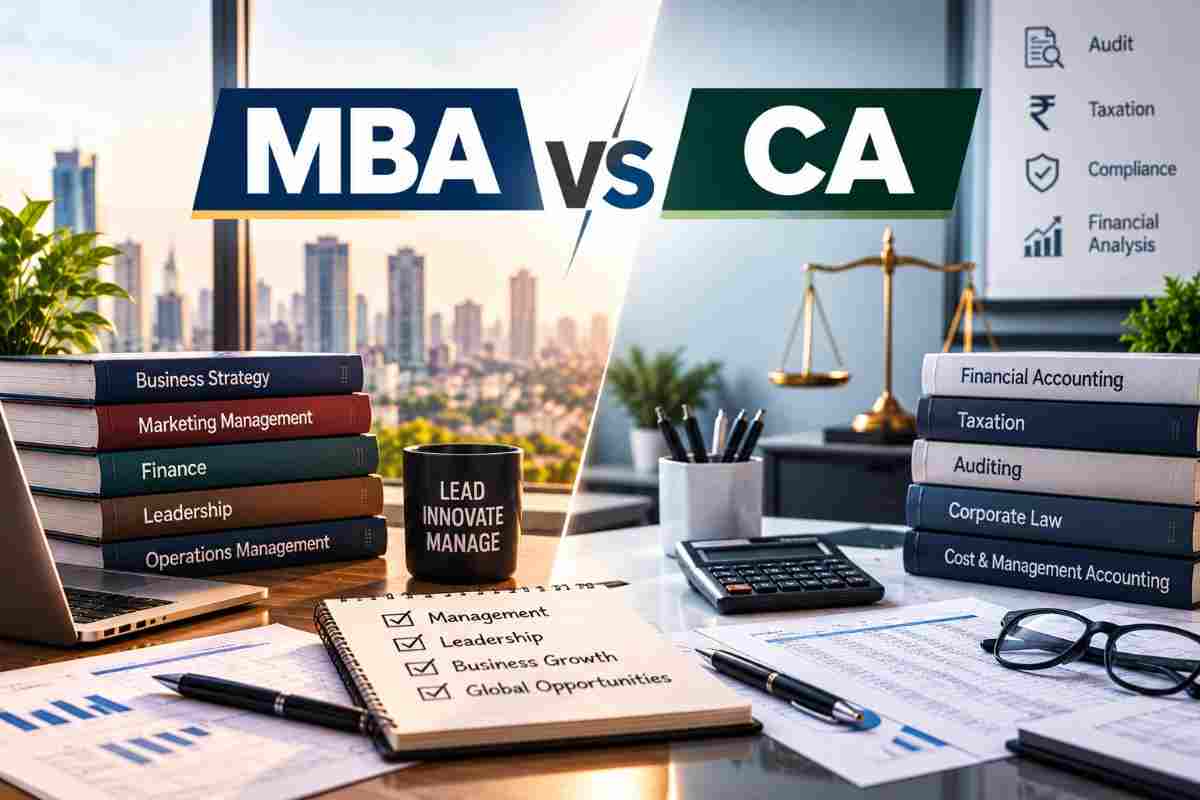
MBA and CA are two popular career paths in India, particularly among commerce graduates. Yet they prepare students for quite different types of work.
An MBA develops broad business and management capabilities. Chartered Accountancy builds deep expertise in accounting, taxation, auditing, financial reporting and finance.
So, the right choice in the MBA vs CA debate depends less on which qualification sounds more prestigious and more on what you actually want to do professionally.
MBA vs CA - Quick Comparison & Which Is Better?
MBA is a postgraduate management degree focused on business, leadership and functional areas such as finance, marketing, HR, operations and analytics. CA is a professional qualification administered by ICAI, with deeper emphasis on accounting, audit, taxation and financial reporting. Neither is universally better-the right choice depends on your career goal.
Factor | MBA | CA |
Full Form | Master of Business Administration | Chartered Accountant |
Type | Postgraduate degree | Professional qualification |
Entry | Usually after graduation | Can start after Class 12 |
Duration | Usually 2 years full-time | Varies with exam progression |
Main Focus | Business management | Accounting and finance |
Cost | Highly institute-dependent | Lower direct academic cost |
Career Flexibility | Broad | More specialised |
Difficulty | Admission + coursework | Multi-stage professional exams |
Careers | Consulting, marketing, finance, HR, strategy | Audit, tax, accounting, finance |
Best For | Broad management careers | Specialist financial careers |
Decision rule: Choose based on the work you want to perform—not salary alone.
What Is an MBA?
MBA stands for Master of Business Administration.
It teaches students how organisations operate and make business decisions. A typical MBA covers finance, marketing, human resources, operations, economics, strategy and business analytics.
Students also learn through:
- Case studies
- Group assignments
- Presentations
- Internships
- Live projects
- Business simulations
Specialisations can include Finance, Marketing, HR, Operations, Business Analytics, FinTech and International Business.
MBA programs differ considerably between institutions. Curriculum, practical exposure, placements and specialisations should therefore be evaluated individually.
What Is CA?
CA stands for Chartered Accountant. In India, the qualification is administered by the Institute of Chartered Accountants of India (ICAI).
Under ICAI's current scheme, students progress through Foundation, Intermediate and Final, alongside prescribed practical training and other requirements.
Current Intermediate subjects include Advanced Accounting, Corporate and Other Laws, Taxation, Cost and Management Accounting, Auditing and Ethics, and Financial/Strategic Management. Final goes deeper into financial reporting, taxation, auditing and advanced financial management.
Current ICAI rules prescribe two years of practical training after passing both Intermediate groups and completing ICITSS.
CA is therefore a professional qualification rather than a conventional university degree.
MBA vs CA: Key Differences at a Glance
Comparison | MBA | CA |
Academic Focus | Broad management | Specialist finance/accounting |
Entry Point | Graduation | Class 12/Foundation route |
Duration | More predictable | Exam-dependent |
Accounting Depth | Moderate in Finance MBA | Very high |
Tax/Audit | Limited | Core |
Marketing/HR | Core options | Not primary focus |
Training | Internships/projects | Mandatory practical training |
Career Breadth | Very broad | Finance-heavy |
Networking | Strong campus element | Professional ecosystem |
Qualification | Degree | Professional designation |
The biggest difference is simple: MBA builds cross-functional business-management capability; CA builds specialist accounting, audit, taxation and financial expertise.
MBA vs CA Eligibility Criteria
MBA Eligibility
A conventional MBA normally requires a bachelor's degree. Minimum marks and entrance requirements vary by institution.
Admission may involve CAT, XAT, NMAT, CMAT, MAT, State CETs or institute-specific examinations, followed by further selection rounds.
Final-year graduates are accepted by many institutions subject to conditions.
CA Eligibility
Students can enter CA through the Foundation route after Class 12.
ICAI also provides a Direct Entry route to Intermediate for eligible graduates/postgraduates. Current requirements include at least 55% for Commerce graduates/postgraduates or 60% for non-Commerce graduates/postgraduates.
The structural difference is important:
CA can begin after Class 12 → MBA normally requires graduation first.
MBA vs CA Course Duration
A full-time MBA in India generally takes two years.
CA has no equally predictable completion timeline.
A student must progress through examinations and complete the required training. Under the current scheme, practical training itself lasts two years.
Exam attempts can extend the overall CA journey.
That makes the distinction:
MBA → fixed academic timeline in most cases
CA → progression-based timeline
MBA vs CA Course Structure & Subjects
MBA Subjects
Common areas include:
- Marketing
- Finance
- Human Resources
- Operations
- Strategy
- Economics
- Business Analytics
CA Subjects
CA goes considerably deeper into:
- Accounting
- Financial Reporting
- Taxation
- Auditing
- Corporate Law
- Cost & Management Accounting
- Financial Management
Subject | MBA | CA |
Accounting | Moderate | High |
Finance | High in Finance MBA | High |
Taxation | Limited | High |
Audit | Limited | High |
Marketing | High | Limited |
HR | High | Limited |
Strategy | High | Included differently |
An MBA Finance student studies finance, but does not receive the same accounting, tax, audit and regulatory depth as a CA.
MBA vs CA Fees & Total Cost
MBA is generally the more expensive route in direct monetary terms.
MBA fees can range from a few lakh rupees at some public institutions to ₹20-25 lakh or more at premium business schools. Living expenses can increase the cost further.
ICAI's published registration-fee structure under the current scheme lists ₹9,000 for Foundation, ₹18,000 for Intermediate and ₹22,000 for Final. Other applicable examination, training or related expenses need to be considered separately.
Cost | MBA | CA |
Academic Fees | Low to very high | Comparatively lower |
Coaching | Optional/varies | Common additional expense |
Living Costs | Significant if residential | Personal situation-dependent |
Opportunity Cost | Often 1-2 years' salary | Longer timeline possible |
Overall Pattern | Higher upfront cost | Lower fees, higher time uncertainty |
Therefore, cheaper does not automatically mean better ROI.
MBA vs CA Difficulty Level
CA Difficulty
CA demands sustained technical preparation across multiple examination stages.
For perspective, ICAI's May 2026 CA Final results showed pass rates of 12% for Group I, 20.49% for Group II and 14.07% among candidates appearing for both groups.
MBA Difficulty
MBA difficulty works differently.
Getting into highly selective business schools can itself be challenging. Once admitted, students face coursework, case studies, presentations, group projects, internships and placement preparation.
So, asking “Is CA harder than MBA?” oversimplifies the issue.
CA has greater exam-progression and technical-accounting intensity. MBA difficulty depends more heavily on entrance competition, institution, workload, teamwork and placement expectations.
CA Pass Rate vs MBA Admission Competition
These numbers should never be compared directly.
For example, ICAI's May 2026 Intermediate pass rates were 10.25% for Group I, 16.11% for Group II and 8.47% for both groups.
Those figures measure performance in a professional examination.
MBA selection rates measure something different: competition among applicants for limited seats, often involving entrance scores plus interviews and other selection criteria.
Both can be highly competitive—but in different ways.
MBA vs CA Salary in India
There is no universal winner for MBA vs CA salary.
MBA compensation depends enormously on the business school, specialisation, previous experience, role and employer.
CA outcomes vary by employer, industry, experience, location, consulting/practice and job function.
A useful current benchmark comes from ICAI. Its 62nd campus placement program for newly qualified CAs from the May 2025 examinations reported an average CTC of ₹12.88 LPA, with the highest domestic offer at ₹26.60 LPA.
The subsequent April-May 2026 campus program reported an average CTC of approximately ₹13.30 LPA.
These are ICAI campus-placement figures, not guaranteed salaries for every CA.
MBA salaries are even harder to generalise because outcomes differ dramatically between institutions.
Highest-Paying Careers After MBA vs CA
High-Paying MBA Careers
Potential paths include:
- Management Consulting
- Investment Banking
- Product Management
- Strategy
- Business Analytics
- Marketing Management
These roles can pay strongly when candidates bring relevant skills and enter competitive employers.
High-Paying CA Careers
Potential paths include:
- Financial Controller
- Audit Manager
- Tax Consultant
- Corporate Finance
- Finance Leadership
- CFO-track roles
- Partner-level professional practice
High-paying positions are career destinations, not automatic starting jobs.
MBA vs CA Career Opportunities
Career Area | MBA | CA | Better Fit |
Finance | Strong | Strong | Both |
Consulting | Strong | Strong | Role-dependent |
Banking | Strong | Strong | Both |
Accounting | Possible | Specialist fit | CA |
Audit | Limited | Specialist fit | CA |
Tax | Limited | Specialist fit | CA |
Marketing | Strong fit | Limited | MBA |
HR | Strong fit | Limited | MBA |
Operations | Strong fit | Possible | MBA |
Strategy | Strong fit | Possible | MBA |
Entrepreneurship | Strong | Strong | Both |
MBA provides greater cross-functional mobility. CA provides deeper access to accounting, taxation, audit, reporting and finance careers.
MBA Finance vs CA: Which Is Better?
This comparison depends on the finance career you want.
Factor | MBA Finance | CA |
Accounting | Moderate | Deep |
Tax | Limited | Deep |
Audit | Limited | Deep |
Corporate Finance | Strong | Strong |
Strategy | Strong | Moderate |
Investment Concepts | Strong | Strong foundation |
Management Exposure | High | Lower |
Regulatory Expertise | Moderate | High |
Choose CA for accounting, audit, taxation, statutory reporting and compliance-heavy finance.
Choose MBA Finance if you prefer broader corporate finance, management, banking, investment, strategy or client-facing business roles.
MBA vs CA for Investment Banking & Finance Careers
For investment banking, an MBA Finance from a business school with strong finance recruitment can offer an advantage through campus access, networking, valuation training and corporate exposure.
CA provides excellent foundations in financial statements, accounting, taxation and corporate finance.
For FP&A, corporate finance and financial consulting, either can work.
For audit and taxation, CA is considerably more directly aligned.
Skills and employer expectations ultimately determine entry.
MBA vs CA for Entrepreneurship
Imagine two people building an e-commerce startup.
An MBA graduate might contribute strongly to customer acquisition, pricing, strategy, operations, hiring and market expansion.
A CA might bring deep understanding of cash flow, taxation, accounting, compliance, financial controls and funding structures.
Both skill sets are useful.
A qualification, however, doesn't make someone a successful entrepreneur automatically.
MBA vs CA Skills Comparison
Skill | MBA Importance | CA Importance |
Leadership | High | Growing with seniority |
Communication | High | High |
Strategy | High | Moderate-high |
Accounting | Moderate | Very high |
Taxation | Low | Very high |
Audit | Low | Very high |
Financial Analysis | High | Very high |
Team Management | High | Important |
Business Analysis | High | High |
There is meaningful overlap in finance, analytical thinking, communication and decision-making.
The difference is primarily depth versus breadth.
MBA vs CA ROI: Which Gives Better Return on Investment?
CA has an important advantage: comparatively low direct academic fees.
But the qualification involves examination progression and a completion timeline that can vary.
MBA usually has a more predictable timeline but can require a substantial upfront investment plus accommodation and opportunity cost.
ROI Factor | MBA | CA |
Direct Cost | Often high | Lower |
Duration Certainty | Higher | Lower |
Placement Access | Institution-dependent | ICAI + market |
Networking | Strong campus potential | Strong professional network |
Career Breadth | High | Specialist-heavy |
Completion Risk | Academic | Exam progression |
Earnings Potential | Wide | Wide |
The better ROI depends on your cost, completion time, role and long-term earnings, not one starting salary.
MBA After CA: Is It Worth It?
For some Chartered Accountants, yes.
A CA may pursue an MBA to move toward:
Accounting/Finance → Strategy → Consulting → General Management → Leadership
It can also strengthen communication, business strategy, leadership and cross-functional decision-making.
But an MBA requires additional money and time.
A CA already progressing successfully toward a specialist finance goal may gain more from work experience than another qualification.
CA After MBA: Does It Make Sense?
It can—but only for specific goals.
CA after MBA may make sense if you want deeper expertise in accounting, audit, taxation, financial reporting or statutory roles.
For someone already pursuing marketing, HR, product management or operations, the considerable CA time commitment may not align with their career.
Start with the target job. Then decide whether CA is actually required or valuable.
MBA vs CA: Which Is Better After 12th?
This requires an important clarification:
Class 12 → CA Foundation → Intermediate → Training → Final
versus
Class 12 → Bachelor's Degree → MBA
A conventional MBA is not an immediate post-Class-12 qualification.
If you already know that accounting, taxation and audit interest you, CA provides an earlier professional route.
If you want broader management exposure, completing graduation and then pursuing an MBA may be more appropriate.
Who Should Choose CA?
CA may suit you if you genuinely enjoy:
- Accounting
- Financial statements
- Taxation
- Auditing
- Financial regulations
- Detailed analysis
- Structured technical learning
You also need patience and discipline for professional examinations.
Ask yourself: Would I enjoy spending years becoming highly knowledgeable about how businesses report, audit, tax and manage their finances?
If yes, investigate CA seriously.
Who Should Choose MBA?
MBA may suit students and professionals interested in:
- Business strategy
- Leadership
- Consulting
- Marketing
- Finance
- Operations
- HR
- Analytics
- Entrepreneurship
It is particularly relevant if you want cross-functional business exposure or management-track opportunities.
Being an extrovert isn't a requirement. Analytical, quiet professionals can succeed in MBA careers too.
Why Choose ITM Business School for an MBA?
For students who decide the management route fits their goals, ITM Business School offers the MBA iConnect 2026-28, a two-year full-time program in Navi Mumbai.
The program currently offers 11 industry-benchmarked specialisations, including Finance, Marketing Management, Human Resource Management, Operations & Supply Chain Management, Business Analytics, FinTech and Financial Services.
Its structure includes a five-month industry-integrated internship, live projects, case studies, a social-sector project and capstone work.
For qualified CAs considering management education, these experiences can complement technical finance expertise with leadership, strategy, communication and cross-functional business decision-making.
ITM's current MBA admission criteria require a bachelor's degree with at least 50% marks, while final-year students can also apply.
Students considering this pathway should explore the current curriculum, specialisations, admission requirements and career opportunities before deciding.
Conclusion: MBA vs CA - Which Career Path Should You Choose?
The MBA vs CA decision is fundamentally about career direction.
CA usually costs less academically but involves demanding professional examinations and specialised training. MBA generally costs more, follows a more predictable academic timeline and provides broader career mobility.
Choose CA if you want specialised expertise in accounting, audit, taxation, reporting, compliance and finance. Choose an MBA if you want broader opportunities in management, leadership, consulting, strategy, marketing, operations, finance or cross-functional business roles.
Neither is universally better.
The better qualification is the one that gets you closer to the work you actually want to do.
FAQs on MBA vs CA
What is the main difference between MBA and CA?
MBA develops broad management and business capabilities. CA provides specialised expertise in accounting, taxation, auditing, financial reporting and finance.
Which is better: MBA or CA?
Neither universally. Choose CA for specialised accounting/finance careers and MBA for broader management and cross-functional business careers.
Which is harder: MBA or CA?
CA has demanding multi-stage professional examinations. MBA difficulty comes from admission competition, coursework, projects, internships, teamwork and placements.
Which has a higher salary: MBA or CA?
Neither always pays more. MBA salaries vary significantly by institute and role; CA earnings vary by experience, employer, industry and practice.
What is the starting salary of MBA vs CA in India?
There is no universal comparison. ICAI's April-May 2026 campus drive reported an average CTC of approximately ₹13.30 LPA for participating newly qualified CAs.
Which course takes longer: MBA or CA?
A full-time MBA generally takes two years. CA completion varies because students must clear multiple examination stages and complete prescribed training.
Which is more expensive: MBA or CA?
MBA is generally much more expensive in direct academic fees. CA's direct registration costs are lower, although coaching and time investment can add costs.
Which has better ROI: MBA or CA?
It depends. CA has lower direct academic cost, while MBA can provide broader career and campus-placement access but may require a much larger investment.
Is MBA Finance better than CA?
Not universally. MBA Finance suits broader corporate-finance and management careers; CA provides deeper accounting, audit, tax and reporting expertise.
Can I pursue MBA after CA?
Yes. Some CAs pursue MBA programs to broaden their opportunities in consulting, strategy, investment banking, management and leadership.
Which is better after B.Com: MBA or CA?
Choose based on your target career. CA fits accounting, audit and taxation; MBA fits management, marketing, consulting, HR, operations and broader finance roles.
Which is better after 12th Commerce: MBA or CA?
CA can begin after Class 12. A conventional MBA requires graduation first, so the two aren't directly equivalent post-12th choices.
Does CA have better job security than MBA?
Not automatically. Job security depends on professional competence, industry demand, employer, specialisation, adaptability and experience.
Who should choose CA?
Students who enjoy accounting, taxation, audit, financial reporting and detailed financial analysis should strongly consider CA.
Who should choose MBA?
Students seeking careers in management, leadership, consulting, marketing, HR, operations, analytics, strategy or broader finance may prefer MBA.
Is ITM Business School a good option for pursuing an MBA?
ITM's current MBA iConnect is a two-year full-time program offering 11 specialisations, experiential learning, live projects and a five-month industry-integrated internship. Students should evaluate these features against their career goals.
