MAT Previous Year Question Papers: Complete Guide + Mock Test for 2026 Aspirants

Introduction to MAT Previous Year Question Papers
Preparing for the MAT exam becomes much easier when you rely on the right study tools — and MAT Previous Year Question Papers (PYQs) are undoubtedly one of the most powerful resources available. Unlike many complex management entrance exams, MAT focuses more on speed, accuracy, and consistent performance rather than extremely difficult questions. This is why solving PYQs can help you understand what matters most, what question types repeat, and how to manage your time effectively.
This guide offers a complete and highly practical overview for MAT 2026 aspirants — what MAT PYQs are, how to use them, difficulty trends, tips, strategies, cutoffs, and why MAT remains one of the most accessible yet rewarding MBA entrance exams in India.
MAT previous year papers are among the most realistic preparation tools for aspirants who want a clear picture of the exam. They help you understand:
- The level of difficulty across sections
- The type of questions that appear frequently
- The speed required to attempt 200 questions
- How the exam mixes simple, moderate, and tricky problems
Most students begin their preparation by solving PYQs before jumping into full-length mocks because MAT is not an exam of surprises — patterns repeat quite often.
Solving PYQs also reduces anxiety. Many students report scoring significantly better once they familiarize themselves with actual question structures through past papers.
Free MAT Previous Year Papers (Solved PDFs)
Get all papers + solutions in one place
Practice MAT 2026 with a Free Mock Test
Practicing MAT previous year question papers helps you understand the exam pattern and difficulty level. However, MAT mock tests help you practice under real exam conditions, where time management and section-wise accuracy matter.
Our MAT mock test is designed as per the latest AIMA MAT exam pattern and covers:
- Language Comprehension
- Mathematical Skills
- Data Analysis & Sufficiency
- Intelligence & Critical Reasoning
This mock test helps you evaluate your preparation level before the MAT 2026 exam.
What Is the MAT Exam? – Complete Overview
The Management Aptitude Test (MAT) is a national-level entrance exam accepted by hundreds of MBA and PGDM institutes across India. It is conducted multiple times a year by AIMA, offering students flexibility in choosing when to appear.
Key Features of MAT:
- Accepted by 600+ colleges
- Multiple modes: CBT, PBT, IBT
- Conducted several times annually (Feb, May, Sept, Dec)
- Moderate difficulty and high scoring potential
- Ideal for working professionals and fresh graduates
MAT tests aptitude in language, reasoning, mathematical skills, data interpretation, and general awareness — all essential skills for management studies.
MAT Previous Year Question Papers with Solutions (Year-wise)
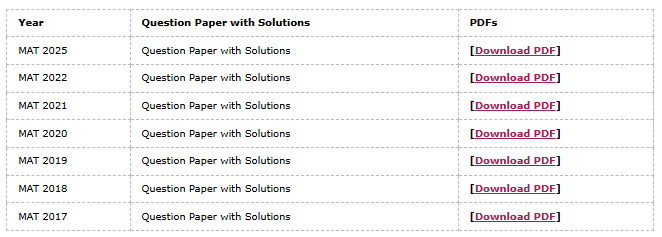
Many aspirants look for MAT previous year question paper PDFs with solutions because they want structured practice. PDFs allow you to study offline, analyse questions at your own pace, and revisit tricky areas. Solutions help you understand shortcuts, elimination techniques, and alternate methods.
Solved MAT Previous Year Papers? Try a Timed Mock Test
Once you complete MAT previous year papers, the next step is to check how well you perform in a timed, full-length mock test. Mock tests help you practice speed, improve accuracy and avoid common mistakes.
Regular MAT mock tests help you:
- Improve sectional time management
- Reduce negative marking
- Build exam-day confidence
Highlights of Major MAT PYQ Sets
MAT 2025 Question Paper
The MAT 2025 paper followed the traditional pattern with familiar question types. Quant was moderately lengthy, reasoning was straightforward, and English was scoring. Solving it helps students understand the latest difficulty balance.
MAT 2022 Question Paper
MAT 2022 included a balanced mix across all sections. Quant had arithmetic-heavy questions, reasoning involved puzzles and analogies, and GK tested recent events. This paper is ideal for building foundational comfort.
MAT 2021 Question Paper
The 2021 paper was slightly easier in quant but more time consuming in DI. English remained predictable. It’s useful for learning speed-driven strategies.
MAT 2020 Question Paper
MAT 2020 was one of the simplest papers, making it perfect for beginners. It helps students understand the MAT mindset and develop base-level accuracy.
Why Solving MAT Previous Year Papers Is Important
MAT is highly pattern-driven, which means PYQs offer a nearly direct preview of the actual exam. Here’s why they matter:
- Boosts Familiarity and Confidence
The more PYQs you solve, the more predictable MAT becomes. Confidence plays a major role when attempting 200 questions in 150 minutes.
- Identifies Strong and Weak Areas
Each section behaves differently. PYQs help you spot:
- Scoring areas
- Repeated question formats
- Your natural strengths
- Topics that need revision
- Enhances Speed and Decision-Making
With 200 questions and limited time, you need to quickly identify:
- Easy questions
- Time-consuming traps
- Which questions to skip
PYQs train your instincts.
- Helps Build Section-Wise Strategy
MAT sections require different approaches. PYQs provide clear insight into how to tackle each one systematically.
MAT Exam Pattern 2026 – Updated Format
MAT has a consistent and predictable exam structure.
Total Questions: 200
Total Time: 150 minutes
Sections (40 questions each):
- Language Comprehension
- Intelligence & Critical Reasoning
- Mathematical Skills
- Data Analysis & Sufficiency
- Indian & Global Environment
Marking Scheme:
- +1 mark for each correct answer
- –0.25 for each incorrect answer
MAT’s mild negative marking encourages attempts — but smart attempts.
MAT Syllabus 2026 – Section-wise Breakdown
- Mathematical Skills
PYQs show strong emphasis on:
- Arithmetic
- Algebra
- Geometry
- Mensuration
- Time–speed–distance
- Profit & loss
- Percentages
Most questions test fundamental concepts rather than advanced mathematics.
- Intelligence & Critical Reasoning
Expect:
- Puzzles
- Analogies
- Series
- Classifications
- Direction sense
- Statement–assumption questions
Reasoning is one of the most scoring sections when practised consistently.
- Language Comprehension
MAT English includes:
- Reading comprehension
- Para jumbles
- Fill-in-the-blanks
- Grammar correction
- Vocabulary questions
RC passages are usually short and direct, making this a high-scoring section for strong readers.
- Data Analysis & Sufficiency
Topics include:
- Tables
- Charts
- Pie diagrams
- Graphs
- Caselets
- Basic data sufficiency
Calculation speed makes a big difference in this section.
- Indian & Global Environment
Covers:
- Current affairs
- Business news
- Government schemes
- International events
This section is not considered for percentile by many colleges but is useful for overall scoring.
How to Use MAT Previous Year Papers for Effective Preparation
- Begin With a Diagnostic PYQ Attempt
Start with one past paper without timing yourself.
This helps you understand your baseline.
- Move to Timed Simulations
Try solving a PYQ within 150 minutes.
Track:
- Question attempts
- Accuracy
- Sectional timing
- Analyse Your Mistakes
Check:
- Why you got questions wrong
- Which section drained your time
- Which topics felt unfamiliar
- Which questions were guessable
A detailed analysis is more valuable than simply completing more papers.
- Build Your Strategy
PYQs reveal whether you should:
- Attempt English first
- Save DI for later
- Avoid spending too long on quant
- Prioritise reasoning
Find a sequence that suits your strengths.
- Practice Short Timed Drills
MAT rewards candidates with quick thinking.
Do 20–30 minute drills for:
- RC
- Puzzles
- Arithmetic
- DI sets
- Maintain an Error Log
Track:
- Repeated errors
- Weak topics
- Time-consuming questions
- Careless mistakes
Review this log weekly for visible improvement.
MAT Previous Year Difficulty Level Analysis
- Mathematical Skills
Difficulty fluctuates slightly year to year but remains moderate with some lengthy calculations.
- Intelligence & Critical Reasoning
Usually straightforward. With enough practice, this becomes the easiest section for many students.
- Language Comprehension
Predictable and scoring. RC difficulty stays moderate.
- Data Analysis & Sufficiency
Often the most time-consuming section. PYQs help you improve calculation efficiency.
- Indian & Global Environment
Difficulty inconsistent - prepare business GK and current affairs for safety.
Expected MAT Cutoff Trends
MAT cutoffs vary widely by institute. Based on past trends:
Top Colleges (85–95 percentile):
- Christ University
- JIMS Rohini
- VIT Business School
- BIMTECH (through CMAT also)
Mid-tier Colleges (70–80 percentile):
- FIIB
- NDIM
- Jaipuria
- IPE Hyderabad
Cutoffs depend on:
- Number of test takers
- Exam difficulty
- College demand
PYQs help you calculate your realistic percentile range.
Why ITM Is a Top Choice After MAT
- Industry-Based Learning
ITM Business School emphasises:
- Practical exposure
- Corporate projects
- Case-based teaching
- Hands-on simulations
This makes learning application-oriented.
- Popular MBA Specialisations
Includes:
- Marketing
- Finance
- HR
- Business Analytics
- Operations
- FinTech
- International Business
- MAT Score Acceptance
ITM accepts MAT scores along with:
- CAT
- XAT
- CMAT
- ATMA
- GMAT
- Strong Placements
ITM consistently places students in sectors like:
- BFSI
- Consulting
- IT
- Retail
- FMCG
- Analytics
- Balanced ROI
Good quality education, strong alumni network, and practical learning models make ITM a preferred choice among MAT aspirants.
MAT Preparation Tips After Solving PYQs
- Prioritise Scoring Sections First
Most students score highest in:
- English
- Reasoning
- Arithmetic-based quant
Start with these.
- Avoid Overthinking
MAT rewards efficiency over complex problem-solving.
- Build Vocabulary Daily
Just 10–15 minutes a day improves English scores tremendously.
- Practice DI Regularly
Speed in calculations determines your DI score.
- Stay Consistent
Consistency is key. Solve at least:
- 3–4 PYQs
- 8–10 mocks
- Weekly sectional drills
Conclusion
MAT Previous Year Papers are the most trusted tools for understanding the real MAT exam. They reveal question patterns, difficulty levels, and time-management challenges far more effectively than theory alone. By solving them regularly and analysing your performance, you develop the speed and confidence MAT demands.
With the right combination of PYQs, mocks, revision, and a well-planned strategy, scoring high in MAT 2026 becomes absolutely achievable. Stay focused, practice smartly, and you’ll walk into the exam hall prepared and confident.
FAQs on MAT Previous Year Papers
Are MAT PYQs useful for preparation?
Yes, they show exact patterns, difficulty levels, and question types.
How many PYQs should I solve?
At least 5–8 complete papers.
Does MAT repeat questions?
Not exact repeats, but similar concepts and patterns appear frequently.
Where can I find MAT PYQs?
Exam prep platforms and coaching websites.
Is MAT easier than CAT?
Yes, MAT is moderately difficult and more speed-oriented.
Can I prepare for MAT without coaching?
Absolutely — PYQs, mocks, and regular revision are enough.
Does ITM accept MAT scores?
Yes, ITM Business School accepts MAT scores for PGDM admissions.