Computer Science Engineering (CSE) vs Computer Engineering: Career, Jobs & Salary
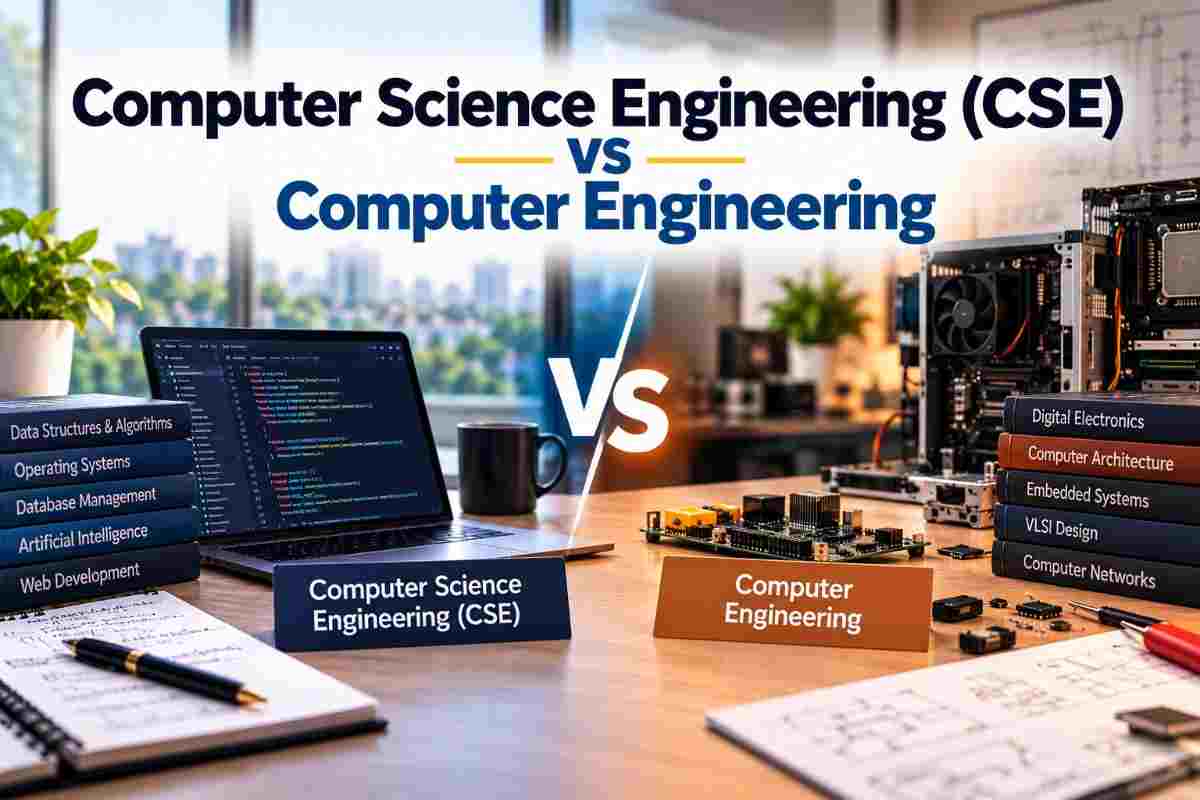
Choosing between Computer Science and Engineering (CSE) and Computer Engineering can be confusing. Both involve computers, programming and problem-solving, and both can lead to technology careers.
The difference lies mainly in what you want to build. CSE concentrates more on software, algorithms, AI and computing systems. Computer Engineering connects software with processors, electronics and physical computing hardware.
Computer Science and Engineering vs Computer Engineering - Quick Comparison
The main difference between Computer Science and Engineering vs Computer Engineering is their academic focus. CSE is primarily centred on programming, algorithms, software, AI, data and computing systems. Computer Engineering combines programming with digital electronics, computer architecture, processors, embedded systems and hardware-software integration.
Factor | Computer Science & Engineering (CSE) | Computer Engineering (CE) |
Primary Focus | Software and computing | Hardware + software |
Hardware Exposure | Limited to moderate | Higher |
Software Exposure | High | Moderate to high |
Core Subjects | DSA, OS, DBMS, AI | Architecture, electronics, embedded systems |
Programming | Extensive | Extensive + low-level coding |
Typical Careers | Software, AI, data, cloud | Embedded, firmware, IoT, hardware |
Best Suited For | Software-focused students | Hardware-software enthusiasts |
Simple takeaway: Choose CSE if software excites you more. Consider Computer Engineering if you want to understand both the code and the hardware running it.
What Is Computer Science and Engineering (CSE)?
CSE studies how computers solve problems through software and computation.
Students typically learn programming, data structures and algorithms, databases, operating systems, computer networks and software engineering. Modern programmes may also provide exposure to AI, machine learning, data science, cloud computing and cybersecurity.
A CSE student might build a mobile application, train an AI model, create a database-backed website or develop a cybersecurity solution.
The emphasis is generally more on software and computational thinking than electronics.
What Is Computer Engineering?
Computer Engineering sits closer to the intersection of computer science and electronics/electrical engineering.
Students can study programming alongside digital electronics, processors, computer architecture, microcontrollers, embedded systems and firmware.
Think of a smart home device. The processor, sensors and electronics need hardware knowledge, while the firmware controlling the device requires programming.
That hardware-software relationship is central to Computer Engineering.
Computer Science and Engineering vs Computer Engineering: Key Differences
Comparison Factor | CSE | Computer Engineering |
Main Focus | Computing/software | Computing + hardware |
Software Depth | Higher | Strong but varies |
Hardware Depth | Lower | Higher |
Electronics | Limited | Significant |
Programming | High | High |
Mathematics | Computing-oriented | Computing + engineering maths |
Lab Work | Programming/software | Software + electronics |
Projects | Apps, AI, cloud | IoT, embedded, robotics |
Career Direction | Software-centric | Hardware-software integration |
The boundary isn't absolute. A Computer Engineering graduate can become a software developer, while a CSE graduate can move toward IoT or embedded technology with additional learning.
Exact curricula also differ between universities.
CSE vs Computer Engineering: Course Duration & Degree Structure
In India, B.Tech/BE programs in both disciplines are commonly four years long, usually divided into eight semesters.
Both can include engineering foundations, mathematics, programming, labs, electives, internships and a final-year project.
The difference becomes clearer as students progress. CSE moves deeper into computing and software subjects, while Computer Engineering generally introduces more electronics, processors and hardware-oriented coursework.
CSE vs Computer Engineering: Subjects & Syllabus
Common CSE Subjects
Typical subjects include:
- Data Structures & Algorithms
- Operating Systems
- Database Management
- Computer Networks
- Software Engineering
- Artificial Intelligence
- Machine Learning
- Cloud Computing
Common Computer Engineering Subjects
Students may study:
- Digital Electronics
- Microprocessors
- Computer Architecture
- Embedded Systems
- VLSI
- Circuits
- Programming
- Operating Systems
Subject Area | CSE Emphasis | Computer Engineering Emphasis |
Programming | High | High |
Algorithms | High | Moderate-high |
Electronics | Low | High |
AI/ML | Higher | Available through electives |
Architecture | Moderate | High |
Embedded Systems | Limited | High |
Universities design curricula differently, so students should compare actual semester-wise syllabi before choosing.
Hardware vs Software: Which Course Focuses on What?
CSE
CSE is generally software-heavy. You could spend more time designing algorithms, writing code, developing applications or working with data.
Projects might include an AI chatbot, cloud application or cybersecurity tool.
Computer Engineering
Computer Engineering combines code with physical computing.
Projects might include a smart IoT sensor, microcontroller-based automation system or robotic controller.
Decision cue: Software product → CSE. Software controlling physical hardware → Computer Engineering may be the stronger fit.
Programming in CSE vs Computer Engineering
Both degrees require coding.
CSE students may work with C, C++, Java, Python, JavaScript and other technologies, depending on the curriculum. Programming supports algorithms, web applications, AI, operating systems and software development.
Computer Engineering students also code but may encounter more C/C++, Assembly, firmware and microcontroller programming.
So Computer Engineering is not a “non-coding” engineering branch. Its programming can simply operate closer to hardware.
Skills You Learn in CSE vs Computer Engineering
CSE Skills
Students can develop skills in:
Programming → Algorithms → Software Development → Databases → AI/ML → Cloud → Cybersecurity
Computer Engineering Skills
The skill set may include:
Programming → Electronics → Microcontrollers → Firmware → Embedded Systems → IoT → Computer Architecture
Programming, operating systems, networks and problem-solving can overlap.
Career Opportunities After CSE
CSE offers access to a broad range of software-oriented careers.
Popular options include:
- Software Engineer: Builds software products and systems.
- Full Stack Developer: Develops front-end and back-end applications.
- AI/ML Engineer: Builds machine-learning systems.
- Data Scientist: Extracts insights and builds models using data.
- Cybersecurity Analyst: Protects digital systems.
- Cloud Engineer: Builds and maintains cloud infrastructure.
- DevOps Engineer: Improves software deployment and operations.
Specialist roles usually require relevant projects, internships and deeper domain skills beyond the degree itself.
Career Opportunities After Computer Engineering
Computer Engineering aligns particularly well with:
- Embedded Systems Engineer
- Firmware Engineer
- Computer Hardware Engineer
- IoT Engineer
- Robotics Engineer
- VLSI Engineer
- Network Engineer
- Systems Engineer
These professionals can work where software meets physical technology.
Computer Engineering graduates can also pursue conventional software development by strengthening algorithms, coding and software engineering skills.
CSE vs Computer Engineering: Job Opportunities Comparison
Career Role | CSE Fit | Computer Engineering Fit |
Software Development | Strong fit | Strong/possible |
AI/ML | Strong fit | Possible with specialisation |
Data Science | Strong fit | Possible with specialisation |
Cybersecurity | Strong fit | Strong fit |
Embedded Systems | Possible | Stronger fit |
Robotics | Strong | Stronger hardware fit |
Hardware Design | Limited | Strong fit |
IoT | Strong software fit | Strong hardware-software fit |
Degrees open doors, but projects, internships, electives and actual technical ability often determine which door a graduate can walk through.
CSE vs Computer Engineering Salary in India
There isn't a reliable universal “CSE salary” versus “Computer Engineering salary” because companies hire graduates into specific jobs.
For example, current Glassdoor India data reports approximately ₹10 LPA average base pay for Software Engineers, with a broad ₹6–18 LPA base range. Embedded Systems Engineers currently average around ₹5 LPA base pay, with roughly a ₹3-7 LPA base range.
These figures compare roles, not degrees.
A Computer Engineering graduate becoming a software engineer may compete for the same compensation as a CSE graduate. Similarly, specialised semiconductor or hardware positions can follow completely different compensation structures.
Salary depends more on role, employer, skills, specialisation, location and experience than the wording printed on the degree.
Which Has More Job Opportunities: CSE or Computer Engineering?
CSE generally provides access to a broader software hiring market. Software development, cloud, data, cybersecurity and AI skills are required across banking, healthcare, e-commerce, technology and many other industries.
Computer Engineering offers more specialised pathways into semiconductors, embedded systems, firmware, IoT, robotics and hardware-software integration.
There is considerable overlap because Computer Engineering graduates can also compete for software roles.
CSE vs Computer Engineering for AI & Machine Learning
For mainstream AI and Machine Learning careers, CSE is generally the more direct academic route.
It aligns closely with programming, algorithms, data structures, mathematics, AI software and data-centric computing.
Computer Engineering becomes particularly interesting when AI moves onto physical devices. Edge AI, robotics, embedded AI, intelligent devices and AI accelerators require knowledge spanning software and hardware.
CSE vs Computer Engineering for Cybersecurity
Both degrees can lead to cybersecurity—but from different directions.
CSE naturally supports application security, software security, cloud security and network security.
Computer Engineering can provide valuable foundations for firmware security, hardware security, embedded security, IoT security and device-level vulnerabilities.
Choose based on what you want to secure: digital software systems, physical computing devices, or both.
CSE vs Computer Engineering for Robotics & IoT
Robotics illustrates why these disciplines increasingly overlap.
Imagine building an autonomous robot.
Computer Engineering can handle its sensors, microcontroller, electronics, firmware and hardware interfaces. CSE skills can power computer vision, AI, path-planning algorithms, cloud connectivity and intelligent software.
Complex technology products often need engineers from both backgrounds.
CSE vs Computer Engineering for Software Development
If your primary goal is software development, CSE is generally the more direct choice.
Its curriculum usually provides deeper exposure to:
- Coding
- Data Structures & Algorithms
- Databases
- Software Engineering
- Operating Systems
- Application development
- System design
Computer Engineering graduates can absolutely become software engineers. They may need to deliberately strengthen software projects and DSA depending on their curriculum.
CSE vs Computer Engineering: Which Is Harder?
Neither course is universally harder.
CSE may feel difficult if you dislike coding, debugging, algorithms, mathematics and abstract computational problems.
Computer Engineering may feel harder if electronics, circuits, processors, hardware labs and low-level programming don't interest you.
The “harder” degree is often the one less aligned with your natural interests.
CSE vs Computer Engineering: Which Is Better for Higher Studies?
After CSE
Popular options include M.Tech/MS programs in Computer Science, AI/ML, Data Science, Cybersecurity and Software Engineering.
After Computer Engineering
Students can explore Computer Engineering, Embedded Systems, VLSI, Computer Architecture, Robotics and IoT.
The boundaries remain flexible. Admission prerequisites, electives, undergraduate projects and research experience can matter as much as the degree title.
CSE vs Computer Engineering: Which Is Better Abroad?
CSE can offer a broader pathway into global software, cloud, AI and data careers.
Computer Engineering can be attractive where industries have strong semiconductor, electronics, automotive, robotics and embedded-system ecosystems.
For higher studies abroad, students should examine the specific university's prerequisites. “Computer Engineering” and “Computer Science” programme structures can differ significantly between countries and institutions.
CSE vs Computer Engineering: Which Course Is Better for You?
Choose CSE If You Enjoy:
Coding, algorithms, AI, software products, data, cloud technology and solving problems mainly through software.
Choose Computer Engineering If You Enjoy:
Electronics, processors, microcontrollers, embedded systems, firmware, robotics and understanding how software communicates with hardware.
Your Interest | Better-Fit Course | Why |
Software applications | CSE | Greater software depth |
AI/Data Science | CSE | More direct foundation |
Electronics | CE | Greater electronics exposure |
Robotics | CE/Both | Hardware + AI overlap |
IoT | CE/Both | Hardware-software integration |
Embedded systems | CE | Core CE strength |
Web/mobile | CSE | Software-oriented |
Semiconductor/hardware | CE | Hardware foundation |
CSE vs Computer Engineering Decision Checklist
Before choosing, ask yourself:
- Do I genuinely enjoy coding?
- Do electronics interest me?
- Would I rather build an app or a smart physical device?
- Does AI/data excite me?
- Am I interested in robotics or IoT?
- Am I comfortable working in hardware labs?
- Which projects would I voluntarily build?
- Which industries interest me?
Mostly software answers point toward CSE. A mix of electronics, programming and physical-system answers points more toward Computer Engineering.
Future Scope of CSE and Computer Engineering
Both fields have strong relevance as technology moves toward Generative AI, agentic AI, cloud computing, cybersecurity, semiconductors, Edge AI, robotics, IoT and autonomous systems.
An interesting trend is convergence.
AI is increasingly moving from cloud servers onto devices. Cars, robots, wearables and industrial systems need sophisticated software running on specialised hardware.
That creates opportunities at the boundary between CSE and Computer Engineering rather than making either discipline obsolete.
Why Choose ITM School of FutureTech for Computer Science Engineering?
ITM School of FutureTech currently offers a four-year, full-time B.Tech CSE & AI program in Navi Mumbai. Its curriculum is co-created with industry professionals and incorporates hands-on projects, hackathons and practical learning.
Students can explore five specialisations: Cyber Security, AI & Data Science, Blockchain Developer, Product Design & UI/UX and AR/VR. The official program information also describes a full-year internship and project-focused learning.
For students specifically interested in areas discussed in this comparison, ITM also has dedicated learning tracks in AI & Data Science and Cyber Security.
Students should evaluate the curriculum, specialisations, eligibility, practical exposure and admission process against their individual career goals rather than selecting a program based on a promised job outcome.
Conclusion: Computer Science and Engineering vs Computer Engineering - Which Should You Choose?
There is no universal winner in Computer Science and Engineering vs Computer Engineering.
Choose CSE if you are primarily interested in coding, software, algorithms, AI, data and cloud computing. Choose Computer Engineering if processors, electronics, embedded systems, firmware, IoT and robotics interest you alongside programming.
Don't choose solely because one branch appears more popular or potentially higher-paying. Choose according to the problems and projects you genuinely want to spend years learning how to solve.
FAQs on Computer Science and Engineering vs Computer Engineering
What is the main difference between Computer Science and Engineering and Computer Engineering?
CSE concentrates more deeply on software and computation. Computer Engineering combines computing with electronics, processors and embedded hardware.
Is Computer Engineering the same as Computer Science Engineering?
No. They overlap in programming and computing fundamentals, but Computer Engineering normally includes greater electronics and hardware exposure.
Which is better: CSE or Computer Engineering?
Neither is universally better. CSE better suits software-focused students, while Computer Engineering suits those interested in both computing and hardware.
Which has more coding: CSE or Computer Engineering?
CSE generally has greater software-programming depth. Computer Engineering also involves substantial coding, including firmware and lower-level programming.
Which has more hardware subjects?
Computer Engineering generally includes considerably more hardware, electronics, processor and embedded-system coursework.
Which course has better job opportunities in India?
CSE generally accesses a broader software market, while Computer Engineering provides specialised hardware-software opportunities alongside possible software careers.
Which has a higher salary: CSE or Computer Engineering?
Neither degree guarantees higher pay. Job role, technical skills, employer and experience are stronger salary determinants than degree title.
Is CSE better for software jobs?
Generally, yes. CSE provides a more direct academic foundation for mainstream software engineering careers.
Which is better for AI and Machine Learning?
CSE is usually the more direct route. Computer Engineering can be particularly relevant for Edge AI, robotics and AI hardware.
Which is better for Data Science?
CSE generally aligns more directly with Data Science because of its programming, algorithms, AI and computational foundation.
Which is better for Cybersecurity?
Both work. CSE aligns strongly with software, network and cloud security; Computer Engineering can be particularly useful for hardware, firmware and IoT security.
Which is better for Robotics?
Computer Engineering offers a strong foundation for robotics hardware and embedded control, while CSE contributes AI, computer vision and intelligent software.
Which is better for IoT?
Computer Engineering is particularly well aligned with IoT hardware and firmware. CSE can contribute cloud, applications, analytics and security.
Is Computer Engineering harder than CSE?
Not universally. Difficulty depends on whether you find programming and algorithms or electronics and hardware more challenging.
Can Computer Engineering graduates become software engineers?
Yes. Strong programming, DSA, software projects and development skills can prepare Computer Engineering graduates for software roles.
Can CSE graduates work in hardware?
Yes, but hardware-intensive positions may require additional electronics, embedded systems or computer-architecture expertise.
Which course is better for studying abroad?
Both can support international study. Your intended specialisation and the target university's admission prerequisites matter more than a universal ranking.
Which course has better future scope?
Both have future scope. CSE aligns strongly with AI, software and cloud; Computer Engineering aligns with semiconductors, embedded intelligence, robotics and IoT.
How should I choose between CSE and Computer Engineering after 12th?
Compare actual curricula and ask whether you would rather spend more time building software or combining software with electronics and physical devices.
Is ITM School of FutureTech a good option for Computer Science Engineering?
ITM offers a four-year B.Tech CSE & AI program with industry-co-created curriculum, projects, hackathons, internships and specialisations including AI & Data Science and Cyber Security.